
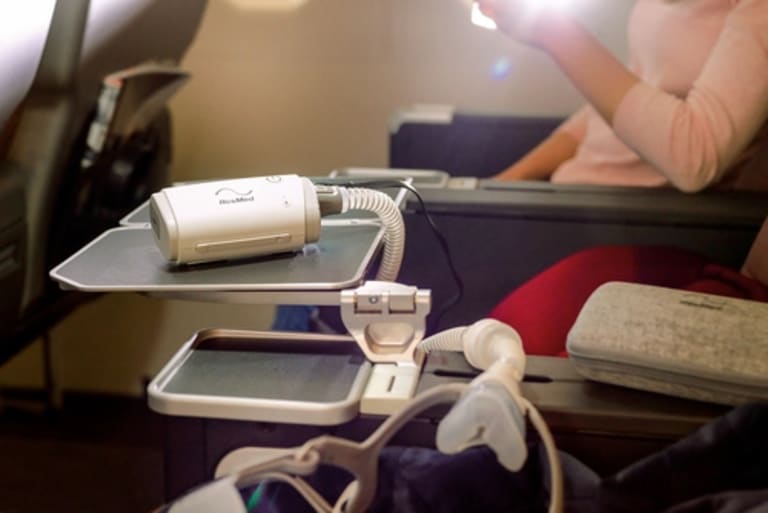
Travel CPAP Machines
Stay on top of your therapy no matter where life takes you. Compact, lightweight and built for life on the move, a travel CPAP helps you stick with treatment wherever you end up sleeping. Browse the newest portable models from top CPAP manufacturers.


Travel CPAP Machines
 $50 off with "BETTERSLEEP50"


 $50 off with "BETTERSLEEP50"
A travel CPAP machine is a smaller, lighter version of a standard CPAP device, built so people living with sleep apnoea can keep their therapy consistent while away from home. Even with their reduced size, travel CPAP units still produce the air pressure needed to keep airways open overnight, whether you're flying, staying in a hotel, camping, or bunking down in a caravan.
These machines are built with portability as the priority. Many offer flexible power sources, such as car cigarette-lighter adaptors, DC converters, and portable battery packs, so therapy can continue in cars, trucks, caravans, boats and other vehicles with suitable power. Several travel CPAP models also use waterless humidifiers, cutting bulk while still adding comfort, which makes packing and managing them on trips far simpler.
A frequent question is whether a travel CPAP can match the reliability of a full-size unit. Generally, the answer is yes. Most travel CPAP machines run on the same therapy algorithms and underlying tech, making them fit for both regular travel and occasional home use. That said, since portability is the main design goal, they often skip full heated humidification, heated tubing, and some of the extra comfort settings found on standard home devices.
As with all CPAP therapy, speak with your doctor before starting treatment. A travel CPAP machine may not suit everyone, particularly those with certain pre-existing conditions. If you have severe bullous lung disease, pneumothorax, abnormally low blood pressure, dehydration, cerebrospinal fluid leak, recent cranial surgery or trauma, heart failure, COPD, or take opioids for chronic pain, talk to your doctor first. Always read the label and follow directions for use, and consult a healthcare professional if symptoms continue.
A travel CPAP machine does the same essential job as a standard unit, delivering prescribed air pressure to keep your airway open, but it's engineered to be far smaller, lighter and more practical away from home. Many people keep a full-sized machine at home for nightly use and a separate travel CPAP just for trips, so therapy stays consistent no matter where they sleep. Travel CPAP units are small enough to slip into a handbag, backpack or carry-on, which suits flying, camping, caravan trips, road travel or shift work. Standard machines tend to be bigger, with a wider base and built-in humidifier, making them better suited to a permanent spot on the bedside table.
Day-to-Day Performance
Today's travel CPAP machines can match the pressure range of full-sized units, and many feature auto-adjusting (APAP) modes, ramp settings and core comfort options, meaning they can serve as either a dedicated travel companion or, with clinician approval, an everyday device. As always, results depend on correct settings, mask fit and consistent use, so check in with your doctor or sleep clinician before changing devices.
Power Sources and Air Travel
Travel CPAP devices generally come with more power flexibility, including 12V/24V compatibility, car or DC adapters, portable battery packs and, sometimes, FAA-approved batteries for long-haul flights. Standard machines mostly run on mains power and can need extra converters or inverters abroad, which makes them less convenient when power supply is limited.
Humidification and Comfort Features
Many travel CPAP units rely on compact or waterless humidification, like heat-moisture exchangers that capture moisture from your breath and return it on the next inhale, removing the need for distilled water. Full-size home units typically come with a larger heated humidifier and richer comfort features, helpful if you deal with dryness, congestion, or a cold or dry climate, though this adds to overall size and weight.
Mask and Tubing Compatibility
A travel CPAP isn't always compatible with every mask or tube on the market, and certain models call for specific travel hoses or connectors to pair with chosen nasal, nasal pillow or full-face masks. Check that your preferred mask works with the device before buying, and make sure you've got the right tubing and adaptors to switch easily between home and travel setups.
Connectivity, Tracking and Sound
Most newer travel CPAP models pair with a smartphone app over Bluetooth, letting you tweak comfort settings, check simple sleep scores and track usage on the road, much like the data features on full-size machines. Noise differs by model: some travel units run as quietly as home machines, while others run a touch louder due to their compact build, so checking decibel specs and reviews helps you pick one that works for you (and anyone sharing the room).
Safety, Build Quality and Medical Guidance
A travel CPAP is built to handle being packed and carried, and most models hold up well to frequent travel and ongoing use when cared for as the manufacturer recommends. As always, anyone with notable health conditions, such as serious lung disease, pneumothorax, unstable heart conditions or recent cranial surgery, should get medical advice before starting positive airway pressure therapy.
A travel CPAP machine is engineered to deliver therapy on par with standard devices, making it a dependable choice for the majority of users. Current travel models include core features like auto-adjusting pressure (APAP), ramp settings, leak management and comfort algorithms that adjust through the night to keep airways open and prevent apnoea events just as effectively as larger machines.
The real trade-offs with a travel CPAP show up in size and certain extras. Smaller motors are common, and humidification is often simplified through waterless or heat-exchange systems rather than the built-in heated humidifiers on standard machines. This works well for most people but may fall short for those needing extra moisture to manage dryness or congestion.
Sound levels on a travel CPAP can run slightly higher because of the compact build, though many models include noise-dampening tech to stay quiet enough for restful sleep. Compatibility is another factor to weigh — some travel devices need particular tubing or connectors, narrowing your options compared with home machines that fit a wider range of masks.
On durability, a travel CPAP is made to survive regular transport and daily wear but may not last as long as standard machines with sturdier motors. Many regular CPAP users keep a full-size unit at home and a travel CPAP for trips, getting the best of both. Always check with your clinician to confirm any travel device suits your therapy needs. On the whole, a travel CPAP delivers solid, dependable therapy along with portability and flexible power options, making it a strong choice for staying on track during travel or shift work. Whether travel or standard suits you best comes down to comfort, humidification needs, mask fit and your lifestyle.
In most cases, yes — your existing mask should pair fine with a travel CPAP machine. Most travel CPAP devices are built for broad mask compatibility, working with standard nasal, nasal pillow and full-face masks from major brands including ResMed, Philips and Fisher & Paykel. This makes switching to a smaller device simple, since you keep the same fit, comfort and seal you already rely on.
That said, a handful of travel CPAP models are the exception. The ResMed AirMini, for instance, only works directly with select mask models unless you add a compatibility adaptor. Other travel devices may use specialised hoses or connectors that need adaptors to fit standard masks. It pays to confirm mask and tubing compatibility before buying a travel CPAP machine so you're not caught out.
Pairing your usual mask with a travel CPAP can shift your experience slightly, since travel units typically run smaller motors and different humidification setups. You might notice subtle changes in airflow feel, noise, or dryness during therapy. Many travel CPAP machines lean on waterless humidification or heat-moisture exchangers, offering less moisture than full-size heated humidifiers. If you're sensitive to dryness, it's worth trial-running the combination beforehand or packing a travel-friendly moisturising spray.
Sticking with the same mask while travelling keeps your therapy steady, since the familiar seal and pressure reduce the adjustment period that comes with new gear and helps avoid leaks that can cut into effectiveness. Frequent travellers often do well keeping a dedicated, compatible mask and any required adaptors packed together with their travel CPAP.
Finally, don't forget the extras — spare filters, tubing suited to your travel CPAP machine, power adaptors and cleaning supplies are all worth packing. Some airlines need advance notice to use a CPAP onboard and may have specific rules around batteries and device types. Keep your CPAP machine and mask in your carry-on to avoid damage or loss in transit. Confirming mask and device compatibility ahead of time means smoother, more comfortable therapy wherever you're headed.
Yes — a travel CPAP machine is permitted on flights and is recognised as essential medical equipment by regulators. Thanks to this classification, it doesn't count toward your carry-on limit, so you can bring it alongside your usual cabin bag. Most travellers keep their travel CPAP with them in the cabin to avoid the damage, loss or temperature swings that can happen in checked luggage. Since travel CPAP units are small and often come with a protective case, they're easy to carry through security and tuck under the seat in front of you mid-flight.
Check your airline's specific rules before flying. Some carriers want pre-approval or advance notice if you intend to use your CPAP onboard. Qantas, Jetstar and Virgin Australia, for example, each have their own forms and processes, sometimes asking for a letter confirming medical need. Most airlines also expect your battery to hold enough charge for at least 150% of the flight time, since in-seat power may be unavailable or unsuitable for CPAP use.
For security screening, your travel CPAP will need to come out of its case for the X-ray scanner, though the mask and tubing can typically stay packed. Some airports add extra checks, like swabbing for explosive residue. A clear plastic bag for your device during screening helps keep it clean, and a medical letter explaining your need for the machine can smooth things along, especially internationally.
There are a few extra things to plan for when flying with a travel CPAP. Most use waterless humidification, so you generally won't need to bring water on board. If yours does need distilled water, remember liquid limits apply — usually 100 mL per container — so carry only small amounts in sealed containers, or skip humidification while flying.
Battery rules also vary by airline, and recent FAA guidance restricts certain lithium-ion batteries, so check your spares meet safety standards.
Weight limits are rarely an issue given how light travel CPAP machines are, but it's still worth checking your airline's carry-on weight allowance. Pack your device in its own separate bag to dodge extra fees and keep it protected. Some carriers ask for advance notice for onboard use or medical accommodations, so reach out to your airline well ahead of your trip to keep things running smoothly.
In short, flying with a travel CPAP machine is well supported by airlines and regulators, but it pays to plan ahead: confirm airline rules, sort out any paperwork, pack batteries thoughtfully, and expect a quick security check. With this groundwork done, you can keep your sleep therapy going comfortably, wherever you're flying.
In many cases, yes, a travel CPAP machine can be used while you fly — though this comes down to the airline's own rules. Most carriers treat CPAP devices as essential medical equipment, but in-flight use isn't automatically approved, so check the requirements well ahead of your trip. Many airlines ask for a medical device approval form or documentation confirming the device meets FAA or TGA standards, and this process can take several days, so sort it out early.
Since most aircraft seats lack accessible power points, airlines typically require battery-only operation during the flight. That makes a compatible external CPAP battery essential if you're planning to sleep on board. As a general guide, your battery should cover at least 150% of the flight duration so you don't run dry mid-air.
Humidification usually isn't recommended in flight, since it uses extra power and raises condensation risk in the cabin's low humidity. This is exactly why most travel CPAP machines come with built-in waterless humidification.
Security checks tend to be straightforward. Both travel CPAP and standard CPAP machines are cleared through airport security globally, though you might be asked to remove the unit from its case. Masks and tubing don't need to come out.
If you're planning to sleep on the flight, a seat with extra room or privacy helps, since setting up your CPAP needs a bit of space. A compact travel CPAP works well here too, with its smaller footprint and quieter run making discreet in-flight use easier.
A travel CPAP can technically be used every night, though it's not usually the best choice as your long-term, primary device.
Portability is the main goal behind a travel CPAP machine — it's built smaller, lighter and simpler to make carrying and using it on the go easy. While it does deliver solid airway pressure and often includes auto-adjusting (APAP) modes and basic comfort features, a few factors make it less ideal as your everyday machine.
Humidification is one of the biggest gaps. Most travel CPAP machines use waterless or passive systems, like heat-moisture exchangers, rather than the full heated humidifiers found on standard devices. Since heated humidification helps prevent dryness, congestion and irritation over time, going without it can make nightly use less comfortable in the long run.
Travel CPAP machines also tend to drop extras like heated tubing and noise insulation to stay compact. This can mean slightly louder operation and a different airflow feel that some find less comfortable than their home unit.
The motors are generally smaller too, and may not hold up as well under constant daily use compared with the sturdier motors in standard CPAP machines.
Standard CPAP machines, fixed-pressure or automatic, usually pack in more — better pressure control, deeper data tracking, wider mask compatibility and refined comfort settings, all geared toward maximising comfort and therapy results over time. They also deliver the full humidification experience needed for nightly airway hydration. Because of these gaps, clinicians generally suggest using a standard CPAP as your main home machine and reserving a travel CPAP machine as a backup for trips, camping or nights away. This way you get the comfort and durability of your main unit while still having a lightweight option for travel.
If you're thinking about using a travel CPAP every night, run it by your healthcare provider or sleep specialist first. They can confirm whether your specific model offers what you need for steady comfort and suggest any adjustments or add-ons that might help.
In short, a travel CPAP machine suits travel and short-term use well, but typically lacks some of the humidification and comfort extras that make a standard CPAP the better pick for full-time, nightly therapy. Using both together often gives the best results for managing obstructive sleep apnoea long-term.
Yes, most current travel CPAP machines include data tracking much like standard devices, fully capable of supporting therapy monitoring, compliance reports and clinical reviews. This matters a lot for anyone needing regular check-ins from doctors, sleep specialists or CPAP consultants, including commercial drivers and those managing long-term sleep apnoea.
How much data a travel CPAP records varies by model, but many capture detailed metrics like usage hours, Apnea-Hypopnea Index (AHI), leak rates, pressure settings and respiratory events overnight. This information is usually accessible via Bluetooth syncing to a manufacturer's app, such as the ResMed AirMini app or similar platforms. These apps let users track sleep progress, get coaching tips and share reports with their healthcare provider directly, supporting adherence and better outcomes even while travelling.
Some ultra-compact travel CPAP units offer simpler data recording, prioritising small size over deep analytics. If detailed tracking matters for your health monitoring or insurance needs, look for a travel CPAP model with strong connectivity, app support and thorough reporting.
Beyond personal benefits, several travel CPAP machines support remote monitoring, letting healthcare professionals check therapy data, review device performance and even adjust settings remotely. This is more typical of home units, but newer travel models are starting to add similar features.
Whether basic or advanced, the data tracking on your travel CPAP machine helps you stay accountable, catch issues early and confirm your treatment is reducing sleep apnoea events effectively, whether travelling or at home.
Picking a travel CPAP machine with solid tracking and app connectivity gives peace of mind and keeps you and your care team informed, no matter where your travels take you.
Most travel CPAP machines weigh between 300–700g, roughly the size of a small water bottle, making them easy to fit in a bag. The ResMed AirMini is small enough to fit comfortably in one hand.
The "best" travel CPAP machine really depends on what matters most to you — size, noise, humidification, mask fit, battery life, app features, or whether it could double as your home device. Since everyone travels differently, the right pick varies from person to person.
One standout option is the ResMed AirMini, currently the smallest CPAP machine available anywhere. Its tiny size makes it a breeze for carry-on bags, hotel stays, caravanning and long-haul flights. Despite its size, the AirMini runs the same core algorithms as ResMed's bedside machines, offering precise auto pressure adjustment (APAP) and solid event detection for effective therapy.
A key feature of the AirMini is its waterless humidification system, HumidX™. Rather than a water chamber, HumidX captures and reuses moisture from your own breath, ideal for travel since there's no distilled water to carry. It delivers humidity levels close to a standard heated humidifier under typical conditions, a real highlight among travel CPAP options.
The AirMini also links to the AirMini app, letting you adjust comfort settings, track sleep data and follow guided setup videos, handy for new users or anyone wanting more insight into their therapy.
Worth noting: the AirMini only works with specific ResMed AirFit and AirTouch masks, each needing the right connector. If mask flexibility or universal tubing matters more to you, another travel CPAP model might be a better fit.
Always check with your doctor before starting any CPAP device, particularly if you have pre-existing conditions like COPD, pneumothorax, severe lung disease, heart failure, or use opioid medication.
A travel CPAP is designed to run as quietly as possible, but smaller motors and tighter airflow paths can sometimes make it sound a touch louder or different in tone compared with a full-size CPAP. Most travel CPAP machines sit around 25–30 decibels, still very quiet — about the level of a soft whisper or rustling leaves.
That said, perception of sound varies. Some people pick up a higher-pitched airflow note from the smaller components, while others notice no real difference. Mask choice, tubing and fit also affect overall noise, since a poorly sealed mask can add leak sounds that get mistaken for machine noise. Many travel CPAP machines now include noise-reduction tech, such as aerodynamic air channels, vibration dampening and quieter micro-turbines, to keep sound to a minimum. If noise sensitivity is a concern, choosing a model known for low decibel output makes a real difference.
Overall, while a travel CPAP might sound a bit different, most people find it quiet enough for nightly use, including in hotel rooms or shared spaces.
Yes, most modern travel CPAP machines support universal voltage (typically 100–240V), so they work safely across different countries' electrical standards with just the right plug adaptor. A bulky voltage converter usually isn't needed unless the manufacturer specifically says otherwise. All you'll likely need is a simple plug adaptor matching your destination's socket shape. These are cheap and easy to find. Before you travel, check the plug style used where you're headed and pack the right adaptor to avoid delays.
Heading on a cruise, into a campervan, or somewhere with unreliable power? Confirm your travel CPAP works with DC power, like 12V or 24V outlets. Many models run fine from vehicle sockets or portable power stations with the right DC converter.
When travelling abroad, always keep your travel CPAP machine in carry-on luggage rather than checked baggage, since airlines treat CPAPs as medical devices. This protects your gear from damage and means you've still got access if checked bags are delayed.
It depends on the brand and model. Plenty of travel CPAP machines use standard CPAP tubing, while others call for proprietary connectors or specialised hoses.
The ResMed AirMini, for example, uses its own tubing and mask connector system built for specific AirFit and AirTouch masks. Because a travel CPAP is built compact, its ports and airflow design can differ from standard machines. This helps keep size down and performance solid but may limit which tubing or masks you can pair with it. If your machine uses a proprietary connector, you'll need a compatible mask or an approved adaptor.
Mask compatibility is worth thinking through when picking a travel CPAP machine. If you'd rather stick with your usual mask, confirm it works with the model you're considering. Some third-party brands offer adaptors to widen compatibility, but always check safety and warranty terms first.
Yes, a travel CPAP machine is well suited to camping, road trips and off-grid living thanks to its lightweight build and flexible power options. Where standard CPAP machines generally need mains power, a travel CPAP is designed for portability and works with DC power and portable batteries. Most brands sell dedicated CPAP battery packs that can run one to three nights of therapy, depending on pressure settings and whether humidification is in use. Waterless systems like ResMed's HumidX are especially handy off-grid, since they skip water entirely and use less power.
A few things worth keeping in mind while camping:
Temperature and humidity: cold weather can affect battery performance.
Power conservation: switching off optional comfort features (like ramp or higher pressure) can stretch battery life.
Regulations: some national parks or flights require batteries in hand luggage.
Many campers pair their travel CPAP with portable power stations or vehicle sockets (12V/24V) to recharge during the day. With a bit of planning, a travel CPAP machine makes it easy to enjoy the outdoors without sacrificing sleep quality or therapy results.
Packing the right gear keeps your therapy comfortable and consistent while you're away. The essentials are your CPAP machine, tubing, mask and power supply, but a few extras make travel a lot smoother.
A padded or hard travel case protects your device from knocks in transit. If you're flying, pack your travel CPAP in carry-on luggage, since airlines treat it as medical equipment and it won't count against your baggage allowance. Some airlines may ask to see your doctor's prescription, so check the requirements beforehand.
Travelling overseas? Pack a universal adaptor and confirm your machine supports global voltage. For off-grid trips, a CPAP battery pack or DC converter for cars and caravans is worth having.
A few more accessories worth packing:
Waterless humidification cartridges (for models like the AirMini)
Mask wipes for fast cleaning
Spare filters in case of dust or pollution
Extension cords for hotels with limited outlets
A backup mask cushion or headgear
Having these on hand keeps your travel CPAP therapy uninterrupted and gives you one less thing to worry about on the road.
window.SoveCategory = { mode: ‘enhanced’, overrides: window.SOV_015_DATA || {}, maskPopup: { enabled: false, scriptUrl: ‘https://res.cloudinary.com/hw6kzsj8k/raw/upload/v1791418903/media/00DBn0000091uhJMAQ/sove-mask-popup.js’, stylesheetUrl: ‘https://res.cloudinary.com/hw6kzsj8k/raw/upload/v1791418944/media/00DBn0000091uhJMAQ/sove-mask-popup.css’, config: window.MASK_MODAL_CONFIG || {} } }; </script>